- Home
- Industries
- HPC & Supercomputing
HPC · Direct Liquid Cooling
Efficiency lists are won at the connection points.
Every system at the top of the Green500 now runs direct liquid cooling, working at 60–70 GFLOPS per watt — a ceiling air cooling cannot approach. When JEDI, the first module of the JUPITER supercomputer, took the No. 1 spot in November 2024, it did so on a warm-water loop full of exactly the connections DryLink builds.
60–70GFLOPS per watt at the Green500 top — all direct liquid-cooled
No.1Green500, Nov 2024 — JEDI, liquid-cooled first module of JUPITER
200kWrack density trajectory pulling HPC into direct liquid cooling
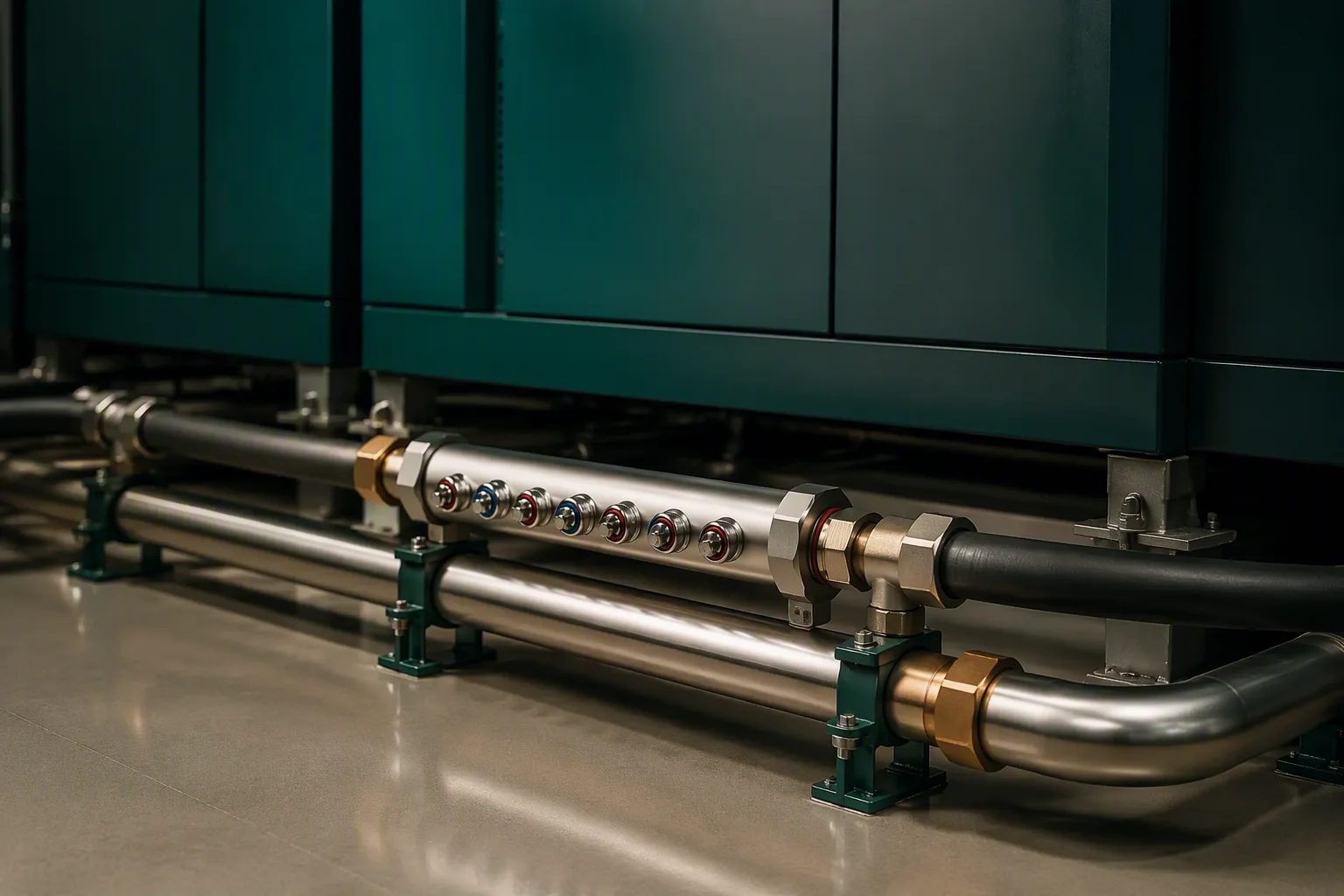
Warm-Water Cooling
Warm water in, free cooling out — if the loop resists add.
Warm-water direct liquid cooling is what turns supercomputer heat into free cooling, because 40–45°C return lines can reject heat without chillers. The OCP UQD service window of +17 to +65°C sits squarely inside that regime, and the standard EPDM seal pack is qualified from -40 to +120°C — so the interface never becomes the reason to chill the water.
Pressure budget matters just as much: measurements on high-density liquid-cooled racks attribute about 56% of total rack pressure drop to the server modules themselves, which leaves the manifold and its couplings almost no room to waste. That is why DryLink sizes manifolds to the LBNL open-specification target of less than 1/40 of the IT equipment loop pressure drop at full flow.
- +17 to +65°C — OCP UQD coolant service window
- ≈56% — rack pressure drop already consumed by server modules
- <1/40 — manifold supply+return ΔP share, LBNL open spec
Supercomputer Delivery Checklist
What a center should be able to verify on delivery.
Supercomputing procurement is audited line by line. These are the checks our paperwork is built to answer, batch by batch.
Interface & design checks
1Interface gauge — every size gauged against the OCP UQD Rev 1.0 envelope, so node and manifold vendors interoperate.OCP REV 1.0
2Cycle rating — 5000 mate/unmate cycles minimum, matched to a documented service cadence per position.5000× MIN
3Warm-water fit — seals and bodies qualified for +17 to +65°C service and -40 to +120°C seal limits.65°C SERVICE
4Pressure floors — 100 psi working and 300 psi burst as OCP minimums, with per-batch pressure records.100 / 300 PSI
5Flow class on paper — Cv and rated flow per size (0.25–2.50 Cv, 0.55–4.7 GPM) stated for every position.PER SIZE
Delivery & documentation checks
1Cleanliness code — production targets ISO 4406 18/16/13, the common industrial liquid-cooling class.18/16/13
2Leak record — 100% vacuum-decay testing per coupling, results printed into the batch report.100%
3Color discipline — red supply / blue return coding on every set to stop reverse installation at 3 a.m.RED / BLUE
4No paperwork, no ship — a batch without its test file is quarantined, never dispatched to the site.HARD STOP
5Spare kits by size — spares broken out per coupling size and node type so the counts are explicit, not bulked.PER NODE TYPE
HPC Interface Table
The numbers an HPC tender asks for.
Quoted from OCP UQD Rev 1.0 floors and the LBNL open specification — attach the table to the tender and we will meet it line by line.
| Parameter | Value | Note for HPC builds |
|---|---|---|
| Coolant service window | +17 to +65°C | covers warm-water direct liquid cooling and free cooling |
| Seal qualification | -40 to +120°C EPDM standard | FKM / FVMQ options for wider loops |
| Sizes | UQD02 / 04 / 06 / 08 — 1/8" to 1/2" | node drops, switch drops and manifold ports in one family |
| Minimum Cv | 0.25 / 0.80 / 1.60 / 2.50 by size | flow capacity without starving the cold plates |
| Rated flow | 0.55 – 4.7 GPM by size | sized against the 1.2 L/min/kW rack basis |
| Spill per disconnect | 0.020 – 0.070 ml @0 psi | node swaps stay drip-free during allocations |
| Working / burst pressure | 100 psi / 300 psi minimum | OCP floors, verified per batch |
| Mate durability | 5000 cycles | spare counts dimensioned from the same figure |
| Height envelope | 1U · 44.45 mm | fits dense node and switch layouts |
| End connections | ORB per ISO 11926-3 · barbs for 1/4"–5/8" EPDM hose | matches manifold and hose assembly practice |
| Color code | red supply / blue return | reverse-installation control on the floor |
| Manifold ΔP target | < 1/40 of IT loop ΔP | LBNL open specification at full flow |
| Cleanliness | ISO 4406 18/16/13 target | reported with the batch documentation |
| Commercial terms | MOQ 50 · standard sets in 15 days · FOB / CIF / DDP | phase deliveries to the installation calendar |
FAQ
Supercomputing questions, answered with numbers.
Do the couplings hold up in warm-water loops above 40°C?
Yes. The OCP UQD service window runs from +17 to +65°C coolant, which covers warm-water direct liquid cooling, and the standard EPDM seal pack is qualified from -40 to +120°C against water-glycol chemistry.
How many spare sets should a cabinet carry?
Dimension spares from the 5000-cycle OCP durability floor and your service cadence — most programs stock a small percentage of positions per node type. We ship spare kits broken out by coupling size so the count is explicit.
What cleanliness level do the couplings and manifolds meet?
Production targets the ISO 4406 18/16/13 cleanliness code, and every coupling passes vacuum-decay leak testing with results documented. Ports stay sealed by the dry-break valves until the moment of mating.
Send the loop schedule. We will quote to the tender line by line.
HPC couplings and manifolds quoted within 48 hours — MOQ from 50 pieces, standard sets ship in 15 days, FOB · CIF · DDP.