- Home
- Industries
- Edge & Colocation
Liquid cooling in buildings that were never plumbed for it.
AI workloads have pushed past 150 kW of heat per rack into edge sites and colocation halls built around a ~15–20 kW air-cooling limit, and rack-class rear doors already carry 75 kW on their own. With cooling consuming 25–40% of facility energy, operators are adding liquid one rack at a time — which puts a premium on couplings a generalist technician can break dry, one-handed, at 2 a.m.
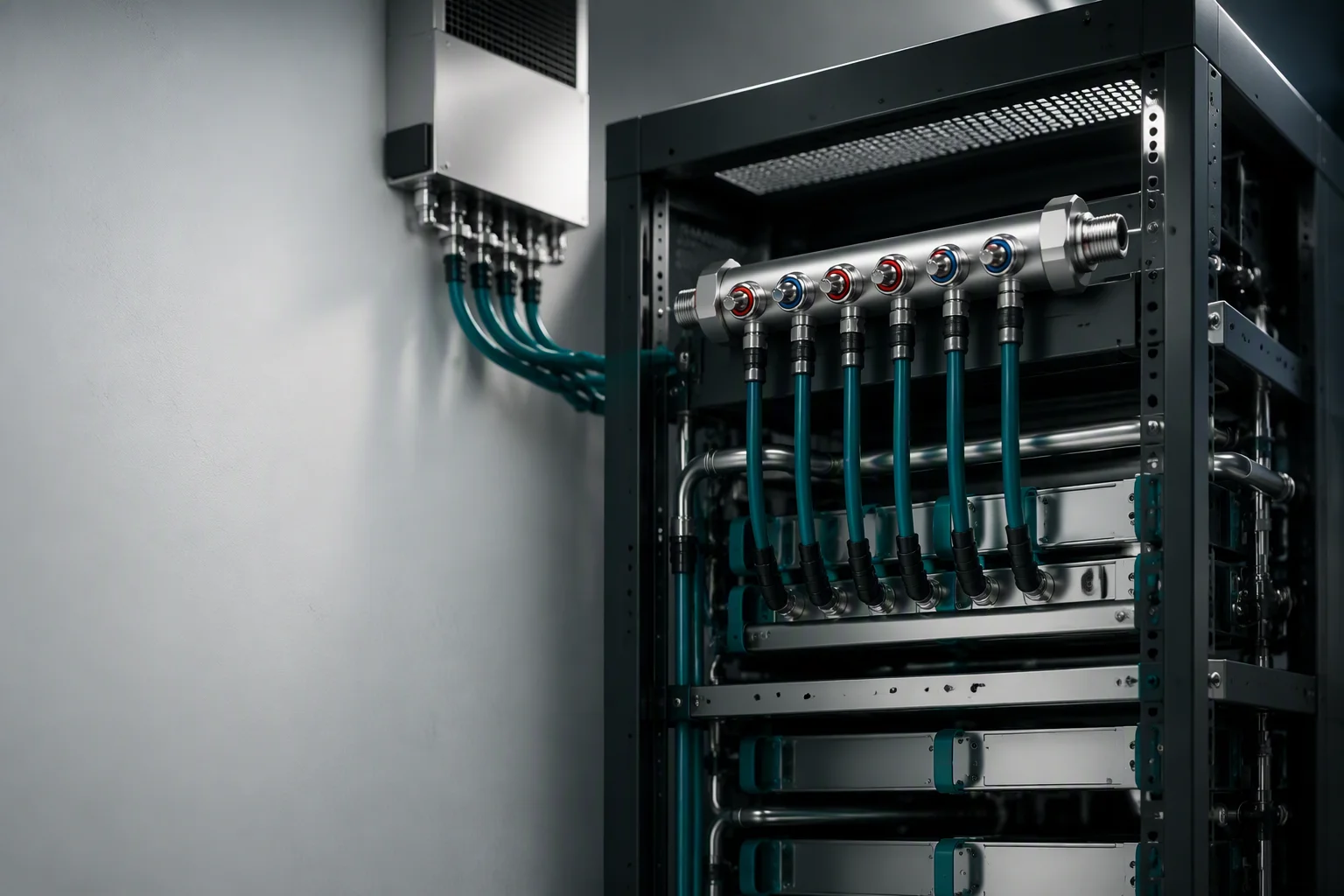
The person holding the coupling is not a fluid engineer.
Edge and colocation maintenance is done by small teams covering many sites, so every connection has to forgive: single-hand push-to-connect operation, dry-break valves that seal both sides at separation, and red-supply / blue-return coding that survives a tired swap. A spill budget measured in hundredths of a milliliter — 0.020 to 0.070 ml per disconnect by OCP size — is what keeps a raised floor and the tray below it dry.
Retrofit discipline shows up in the envelope too: couplings keep the OCP 1U, 44.45 mm height profile so existing racks and cable management stay untouched, and seals qualified from -40 to +120°C tolerate unheated rooms, transport and storage from -40 to +75°C before the hardware is even racked.
- 150+ kW — heat per rack entering edge and colo halls
- 75 kW — what a rack-class liquid cooling door already carries
- 25–40% — share of facility energy consumed by cooling today
Specified for sites you cannot staff like a hyperscale hall.
The rows below are what make a coupling safe in the hands of a rotating, multi-site maintenance crew.
| Parameter | Value | Why it matters off the main campus |
|---|---|---|
| Disconnect effort | single-hand push-to-connect, no tools | any technician on shift can service a tray |
| Spill at disconnect | dry-break, 0.020 – 0.070 ml class @0 psi | raised floors and live gear below stay dry |
| Color coding | red supply / blue return | reverse-installation control without training decks |
| Seal qualification | EPDM -40 to +120°C | unheated edge rooms and winter transport |
| Storage & transport | -40 to +75°C | hardware survives the warehouse before the rack |
| Pressure floors | 100 psi working / 300 psi burst | OCP minimums, verified per batch |
| Cycle rating | 5000 mates minimum | a decade of preventive-maintenance windows |
| Height envelope | 1U · 44.45 mm | retrofit into existing racks and cable plans |
| Flow classes | 0.55 – 4.7 GPM (UQD02–08) | node drops through rack-manifold sizing |
| Cleanliness | ISO 4406 18/16/13 target | loops filled once, then serviced rarely |
| Batch documentation | 100% leak test report per batch | evidence for commissioning and MSA files |
| Commercial terms | MOQ 50 · 15 days standard · FOB / CIF / DDP | phased releases matched to site rollouts |
Tick these before coolant enters the white space.
Two lists — one for the fit-out team, one for the operations team. Both map to numbers we can document per batch.
Fit-out checks
Operations checks
Edge and colo questions, answered with numbers.
We operate the hall but do not engineer the servers — who designs the loop?
Can generalist site staff really disconnect these one-handed?
Is the MOQ workable when one site only needs a few dozen sets?
Retrofitting liquid into live halls? Start with the connections.
Couplings and manifolds for edge and colocation quoted within 48 hours — MOQ from 50 pieces, phased site deliveries, FOB · CIF · DDP.