- Home
- Industries
- Energy Storage
Energy Storage · BESS Liquid Cooling
Every cell inside its window, every pack swappable dry.
Lithium wants to live between 15 and 35°C, and liquid cooling is what holds cell-to-cell spread at 3°C or better inside that window — air-cooled containers drift wider and age unevenly. Stationary BESS liquid cooling is forecast to compound at 23.1% a year, and tier-one fluid-system suppliers already ship quick-connect fittings as standard delivery. DryLink builds the dry-break versions: coolant stays in the string while a module comes out.
Thermal Numbers
The temperatures that decide pack life.
Battery engineering gives the loop its targets — the coupling has to hold them without becoming the maintenance problem itself.
≤3°Ccell-to-cell spread held by liquid cooling, versus wider air-cooled drift
15–35°Cthe operating window lithium cells tolerate best
23.1%CAGR forecast for stationary BESS liquid cooling from 2026
30–40°Cpack temperature maintained by liquid cooling — air runs 37–45°C
Pack-Level Service
Coolant and cells never meet — that is the design job.
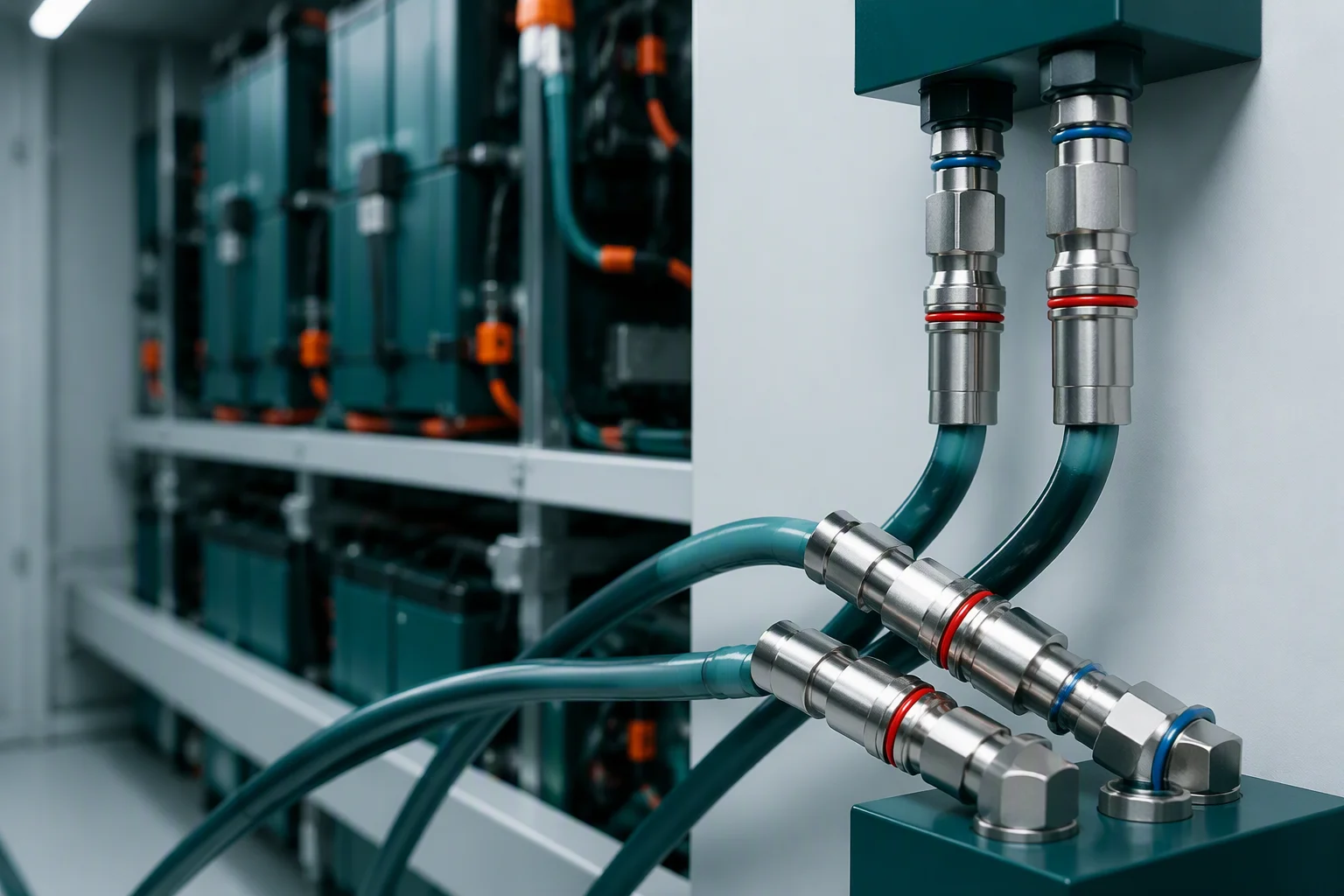
A battery container is a sealed box full of electronics that water must never reach, serviced by crews who visit site by site. Quick disconnects at the pack and cluster boundaries are what make module replacement a five-minute, toolless job: the dry-break valves seal both sides at separation, holding a 0.020–0.070 ml class spill budget, so the string stays full and the tray stays dry.
Outdoor duty sets the materials. Containers see winter transport and cold starts, so the standard EPDM seal pack is qualified from -40 to +120°C for 50% glycol-class coolant, and cycle ratings of 5000 mates cover annual preventive maintenance for the life of the container.
- ≤5°C → ≤3°C — from the spread air struggles to hold, to what liquid cooling delivers
- -40 to +120°C — EPDM seal window for outdoor containers
- 5000 mates — cycle floor covering a decade of annual service
Pack & Cluster Interface Table
What a BESS loop asks of its connections.
Port maps in storage are set by the pack layout, not by a fixed industry standard — so we build to your drawing and document the rest.
| Parameter | Value | Why it matters in a container |
|---|---|---|
| Disconnect type | dry-break, both sides self-seal | coolant stays in the string during module swaps |
| Operation | single-hand push, no tools | field crews rotate across many sites |
| Spill budget | 0.020 – 0.070 ml class @0 psi | zero visible drops over live cells |
| Coolant | 50% water-glycol class | freeze protection for outdoor containers |
| Seals | EPDM -40 to +120°C · FKM / FVMQ options | winter transport and cold starts |
| Pressure floors | 100 psi working / 300 psi burst | OCP minimums, far above BESS pump heads |
| Cycle rating | 5000 mates minimum | annual pack maintenance for the container life |
| Color coding | red supply / blue return | mis-installation control at swap speed |
| Ports | manifold port map to drawing | follows the pack layout — no fixed industry standard |
| Cleanliness | ISO 4406 18/16/13 target | narrow cold-plate channels inside packs |
| Documentation | 100% leak test report per batch | traceability for battery-certification files |
| Commercial terms | MOQ 50 · 15 days standard · FOB / CIF / DDP | container-by-container release scheduling |
FAQ
Storage questions, answered with numbers.
What coolant do BESS liquid cooling loops run, and which seals survive it?
Stationary storage loops run water-glycol mixtures for freeze protection — the 50% glycol class. The standard EPDM seal pack is qualified from -40 to +120°C against water-glycol chemistry, with FKM and FVMQ options for wider envelopes.
Where should quick disconnects sit inside a container?
At the pack and cluster boundaries, fed from a rack manifold ported to your drawing. That placement lets a module be swapped without draining the string, while the dry-break valves keep coolant off the cells during the swap.
What lead times should a container rollout plan for?
MOQ starts at 50 pieces and standard coupling sets ship in 15 days. Manifolds with custom port maps typically run 30–45 days after drawing approval, released container by container.
Send the pack layout. We will port the manifold to it.
BESS couplings and manifolds quoted within 48 hours — MOQ from 50 pieces, standard sets ship in 15 days, FOB · CIF · DDP.