- Home
- Capabilities
- Sealing Technology
Sealing technology from -55 to +200°C.
The elastomer is the only wear part in a dry-break coupling. DryLink builds UQD sets on EPDM as standard and offers FKM, FVMQ, NBR and HNBR — a -55 to +200°C qualification span matched to your coolant, from DOWFROST LC 25 to JEFFCOOL ISF-25 chemistry.
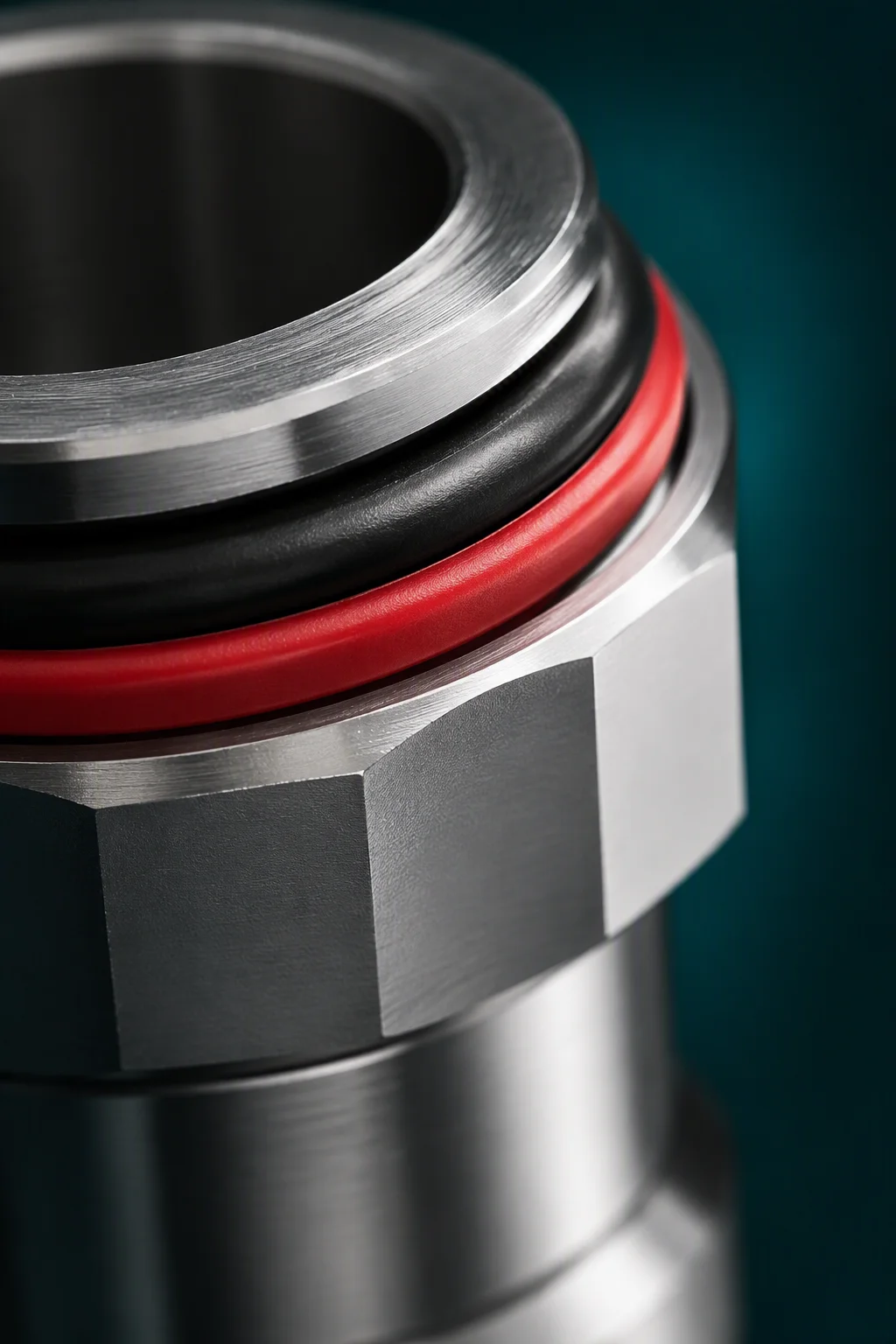
One compound never fits every loop.
OCP UQD Rev 1.0 qualifies wetted materials against DOWFROST LC 25 and JEFFCOOL ISF-25 and references IEC 62368-1 Annex G.15 for coolant-contact safety. Inside that envelope, temperature does the deciding: a warm-water loop at 90°C and a glycol loop at 45°C need different elastomers, and no single compound covers both without compromise.
EPDM is the DryLink standard for water-glycol service from -40 to +120°C. Where the loop runs hotter, FKM extends the ceiling to +200°C; where transport and cold starts dominate, FVMQ keeps its flexibility down to -55°C. NBR and HNBR close the gap for cost- and abrasion-driven builds.
- -40 to +120°C — EPDM standard service window
- DOWFROST / JEFFCOOL — coolant families the seal pack is qualified against
- IEC 62368-1 G.15 — safety clause referenced for coolant-contact materials
Five compounds, one qualification baseline.
Use the temperature rows to shortlist, then let the coolant and cycle count confirm. Every row below is part of the batch documentation we ship.
| Seal parameter | Value / Range | How it is applied |
|---|---|---|
| EPDM — standard | -40 to +120°C | default seal for water-glycol UQD loops |
| FKM — option | -15 to +200°C | elevated-temperature and glycol-free service |
| FVMQ — option | -55 to +155°C | widest low-temperature flexibility |
| NBR — option | -40 to +80°C | cost-driven moderate-temperature builds |
| HNBR — option | -40 to +150°C | abrasion-and-heat combinations |
| OCP service window | +17 to +65°C coolant | operating envelope defined by UQD Rev 1.0 |
| OCP transport window | -40 to +75°C | storage and shipping envelope per the spec |
| Qualified coolants | DOWFROST LC 25 · JEFFCOOL ISF-25 | wetted-material compatibility baseline |
| Safety reference | IEC 62368-1 Annex G.15 | clause referenced for coolant-contact materials |
| Leak budget | 0.020 – 0.070 ml per disconnect | OCP limit by size, UQD02 through UQD08 |
| Cycle rating | 5000 mate cycles minimum | OCP floor validated on batch samples |
How a seal lot earns its place in a set.
Seals are small, cheap and catastrophic when wrong — so compound lots are controlled harder than the metal around them.
Incoming & compound control
In-process & outbound verification
Seal questions, answered with numbers.
Which seal should I choose for a 45°C glycol loop?
Can seal compounds differ across one manifold?
What seal data ships with a batch?
Tell us the coolant and the temperatures. We will name the compound.
Loop profile in, seal recommendation back within 48 hours — MOQ from 50 pieces, standard sets in 15 days.