- Home
- Capabilities
- Testing & Cleanliness
Leak testing & cleanliness, one set at a time.
A coupling is a pressure vessel you open on purpose. Every DryLink set passes vacuum-decay and helium leak testing before packing — on benches with 5×10⁻¹² mbar·l/s detector-class sensitivity — with cleanliness held to ISO 4406 18/16/13 and the report shipped in the carton.
The bench decides, not the brochure.
This is the sequence a UQ04 set sees before its carton is sealed — the same records that ship as the batch report.
$ vacuum-decay leak ....... PASS <1×10⁻⁴ mbar·L/s
$ helium verification ..... PASS 1.4×10⁻⁶ atm·cc/s class
$ flow @ 1.7 GPM .......... PASS Δ 1.8% of dash-04 rating
$ cycle sample 5000× ...... PASS OCP floor cycle
$ ISO 4406 particle count . 18/16/13 release codes
$ dry-break disconnect .... ZERO visible drip @ 0 psi
# leak + flow + soak records ship in the box ▊
What is tested, to what limit, on what scope.
Scope matters as much as limit — a datasheet number means little until you know whether it was measured on one golden sample or on the whole batch. The matrix below names the method, the acceptance limit and the scope side by side, and the same table is what your batch report follows.
| Test | Method / Limit | Scope |
|---|---|---|
| Helium leak test | mass-spectrometry benches, 5×10⁻¹² mbar·l/s detector class | batch verification on leak-critical sets |
| Production leak acceptance | ~1.4×10⁻⁶ atm·cc/s order | release criterion for sealed sets |
| Vacuum decay | pressure-loss method, <1×10⁻⁴ mbar·L/s | 100% of sets before packing |
| Flow verification | rated flow at class GPM — 1.7 GPM on dash-04 | sampled per batch |
| Mate/unmate durability | 5000 cycles — OCP floor | batch validation sample |
| Dry-break check | disconnect at 0 psi, 0.020 – 0.070 ml budget by size | OCP limit, UQD02 through UQD08 |
| Cleanliness code | ISO 4406 particle counting | target 18/16/13 on release |
| What 18/16/13 means | ≥4 µm: 1300–2500 · ≥6 µm: 320–640 · ≥14 µm: 40–80 particles/mL | three-band concentration cap |
| Salt spray | ISO 9227 neutral, 48 h | surface treatments and coatings |
| Glycol soak | 72 h at -40 to +120°C class endpoints | sampled sets before release |
| Report | leak, flow, soak and cleanliness records | ships inside every carton |
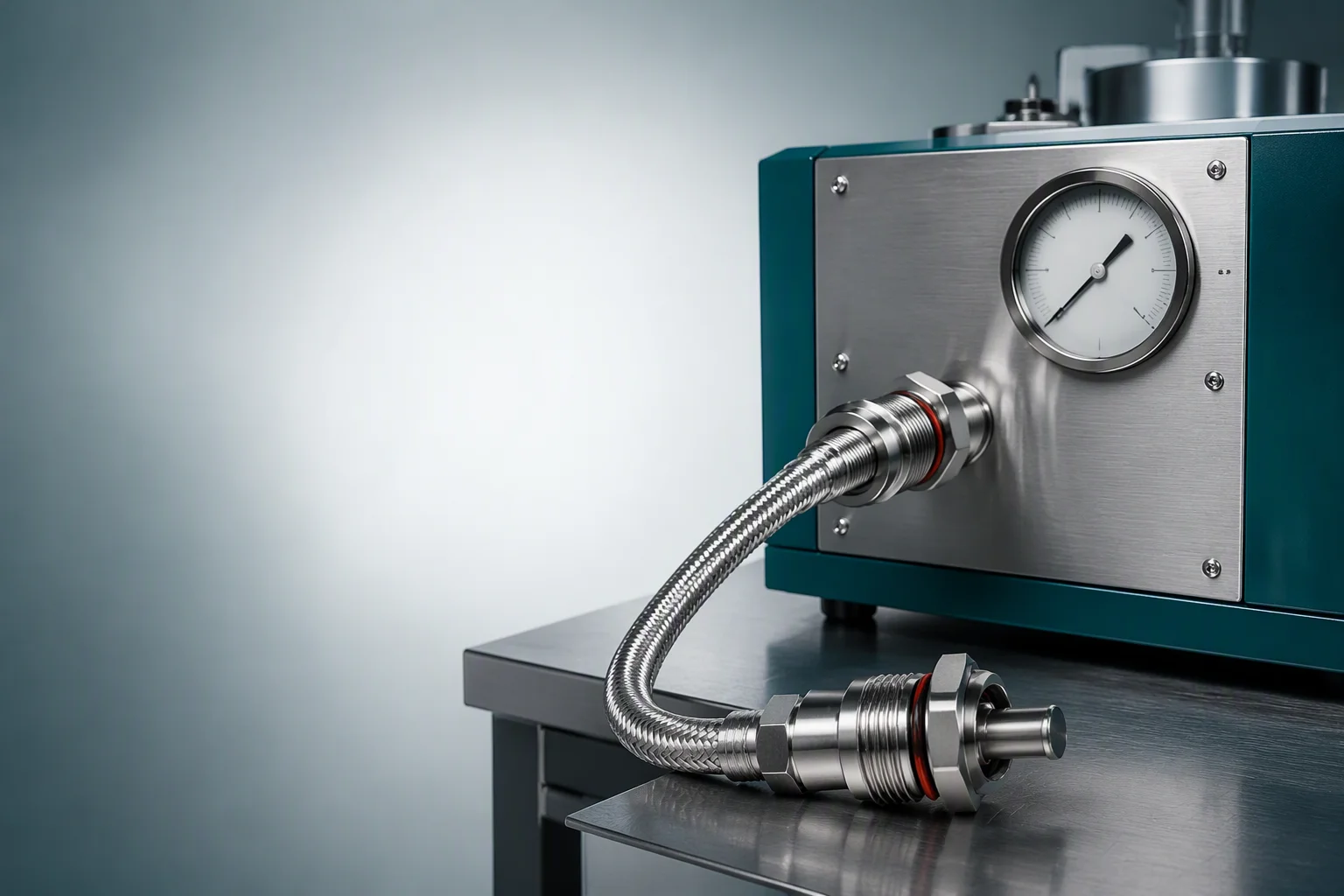
If it was not recorded, it did not pass.
Leak benches are only half the job — the other half is making results travel. Each carton carries the batch report: serial range, leak values, flow check and cleanliness code, so your incoming inspection can audit the batch without asking us a single question.
When a loop is filled with $9,000-per-minute downtime on the other side of the fitting, a test report is not paperwork — it is the reason your quality team approves the second order. Reports are archived against serial ranges, so a question raised a year later still gets the original numbers, not a summary of them.
- 5×10⁻¹² mbar·l/s — detector-class sensitivity behind the helium benches
- 18/16/13 — ISO 4406 cleanliness code held as the release target
- 48 h — neutral salt-spray verification on surface finishes
Testing questions, answered with limits.
Do you test every piece or only a sample?
What does ISO 4406 18/16/13 actually guarantee?
Can you test to our leak criterion instead?
Ask for the report before you ask for the price.
Sample batch reports are available with any quotation — 48-hour response, MOQ from 50 pieces, test docs in every box.