Sizing by port count, not Cv
An eight-port manifold built on dash-02 — minimum Cv 0.25, 0.55 GPM — starves branches budgeted at 1.7 GPM. Pick the size class from the flow table first and let the port count follow, or pay the difference in ΔP.
A quick disconnect is chosen four times: by flow, by envelope, by end connection and by seal. Choose all four before the drawing goes out, and the DFM review comes back as a confirmation instead of a correction list. The table below is the short version our engineers work from — and the 48-hour review applies it to your drawing, free with every quotation.

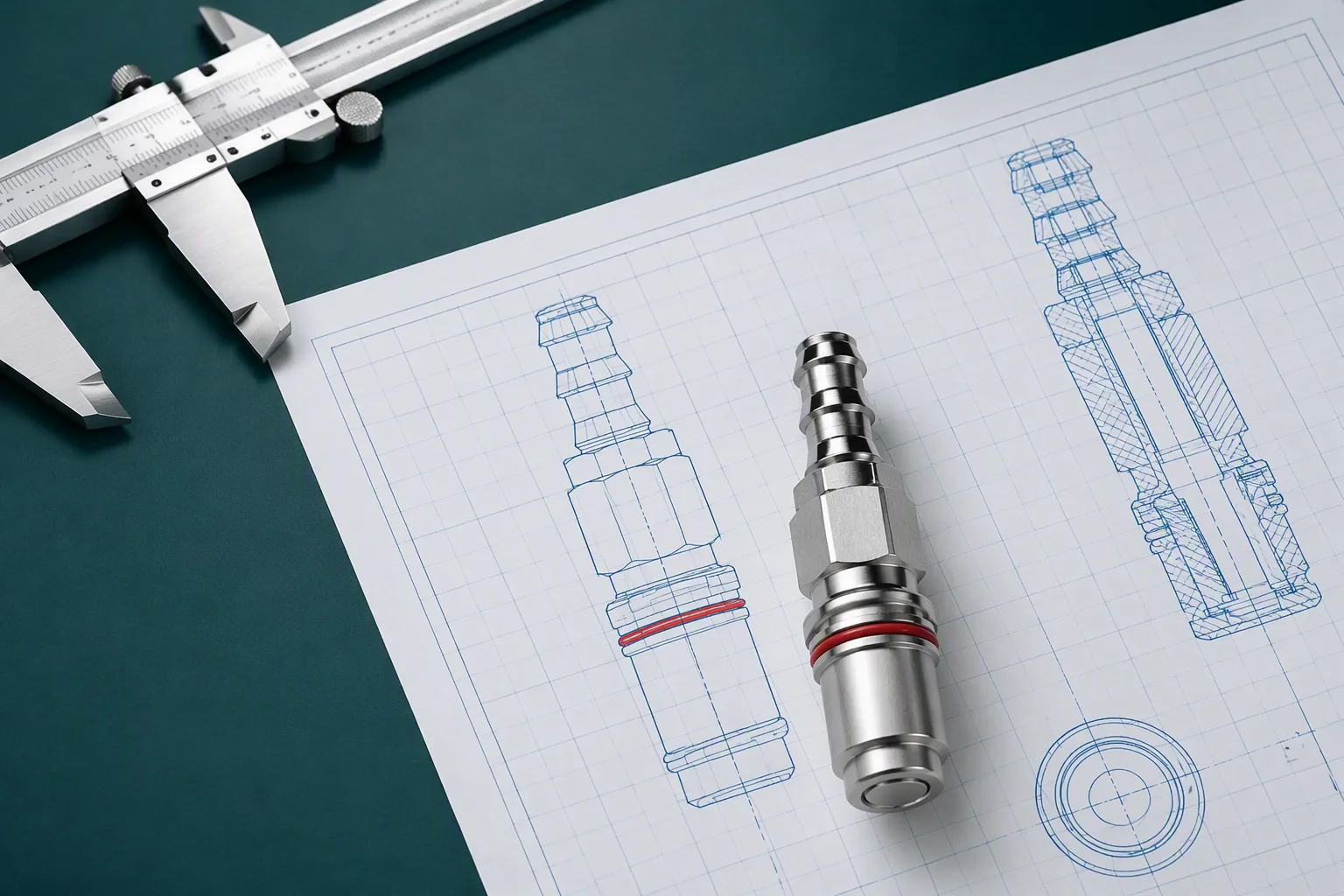
Send a drawing and the review covers the port map against your flow split, the size class against the Cv table, the envelope against your rack pitch, the end connections against your hose and tooling, and the seal compound against your coolant chemistry. What comes back is a marked drawing and a firm lead time — not a request for more information.
Each row is a decision your drawing makes for us — written as the reference standard plus the one thing to verify before release.
| Design decision | Reference | What to check |
|---|---|---|
| Size class by flow | OCP UQD02–08 | minimum Cv 0.25 / 0.80 / 1.60 / 2.50 and rated flow 0.55 / 1.7 / 3.0 / 4.7 GPM by size |
| Spill budget | OCP, per size | 0.020 / 0.025 / 0.035 / 0.070 ml per disconnect at 0 psi — size the maintenance plan around it |
| Pressure class | OCP floor | 100 psi working, 300 psi burst minimum; standard DryLink bodies run a 20 bar working class |
| Threaded ends | ISO 11926-3 | ORB ports on plug ends — gauged before assembly, not after |
| Hose ends | barb 1/4"–5/8" | reinforced EPDM hose per the OCP annex; push-lock or clamped per hose brand |
| Envelope | OCP 1U | 44.45 mm pitch height — check pull clearance and hose bend radius, not just the installed pose |
| Contact & coding | OCP | ball contact surfaces ≥24 HRC; red-hot / blue-cold colour convention at the rack |
| Manifold ΔP | LBNL open spec | supply plus return under 1/40 of the IT equipment loop pressure drop |
| Rack flow basis | industry benchmark | 1.2 L/min per kW — an 80 kW rack moves ≈96 L/min with an ~18 psi rack budget |
| Seal compound | temperature / coolant | EPDM -40 to +120°C standard, FKM to +200°C, FVMQ to -55°C; matched to DOWFROST / JEFFCOOL-class coolants |
| Durability basis | OCP floor | 5000 mate cycles design basis; 15-year storage, 20-year service life classes |
| Custom bores | DryLink manifolds | DN03–DN10 — pick by Cv and branch flow, never by port count alone |
Run this list and the 48-hour review becomes a rubber stamp — skip it and each line becomes a revision loop measured in weeks.
None of these fail a datasheet — they fail a loop. All four cost less to fix on the drawing than in the rack.
An eight-port manifold built on dash-02 — minimum Cv 0.25, 0.55 GPM — starves branches budgeted at 1.7 GPM. Pick the size class from the flow table first and let the port count follow, or pay the difference in ΔP.
The OCP 44.45 mm pitch envelope leaves no room for a hand-push pull at an awkward angle. Draw the service motion — gloved hand, hose sweep, latch access — not just the installed position that fits the CAD.
NBR tops out at 80°C and dislikes glycol inhibitors; EPDM runs -40 to +120°C in water-glycol loops. The wrong compound passes the leak bench on day one and swells into a maintenance call in month nine.
Blind-mate UQDB pairs eat installation tolerance with self-alignment — designs in this class compensate around ±1 mm to ±1.3 mm radially — but the rack still has to draw in the listed radial and angular allowance. "It self-aligns" is not a mounting spec.
The 48-hour DFM review is free with every quotation — port maps, Cv classes and envelopes included.