UQDB vs UQ04: which coupling fits your loop?
The two names answer different questions. UQDB says how a coupling mates — blind, latch-free, self-aligning. UQ04 says how much it flows — the dash-04 (1/4") OCP tier, Cv 0.80 minimum, 1.7 GPM rated. Confusing them at design time is the most common selection error we quote against, so this brief separates form from size, then puts the dash-04 tier side by side to show what actually changes.
DL-002 · Published 2026-09-06 · 8 min read
Start with the orthogonality, because everything else follows. UQDB names the interface form: a blind-mate pair with no latch, where the socket leads the plug, centers it radially and seats both valves in one straight push. UQ04 names the size: the OCP dash-04 tier on a nominal 1/4" interface, with a minimum Cv of 0.80, a rated flow of 1.7 GPM and a spillage ceiling of 0.025 ml per disconnect at 0 psi. The two axes cross — a UQDB04 is both blind-mate and dash-04 at once.
In practice the industry leans on each form where it is strong: blind-mate at fixed planes inside the rack, hand-push on flexible lines where a technician's hands are the alignment system. Get that mapping right and the rest of the datasheet mostly confirms the decision.
Where each form earns its keep.
Same standard, same floors, different mechanics — the choice is about geometry and service, not quality tier.
UQDB — built for the rack plane
In a GPU tray, the manifold is bolted to structure while the cold plate floats on the board, so every millimeter of assembly tolerance lands on the coupling. A blind-mate UQDB absorbs that error instead of transferring it to a technician: published class parts carry 0.8–1.3 mm of radial compensation, mate in a single straight push at 53–71 N of hand-force across the size range, and lock without a latch to fumble at the back of a rack. Both valves close on separation, so the tray below stays dry — the difference between a five-minute swap and drying out a shelf.
- 0.8 – 1.3 mm — radial alignment compensation published across the UQDB class
- 53 – 71 N — mate force from UQDB02 to UQDB08, serviceable by hand
- 2 / 2 valves — both sides seal at separation, no drain and no drip
UQ04 — built for the service loop
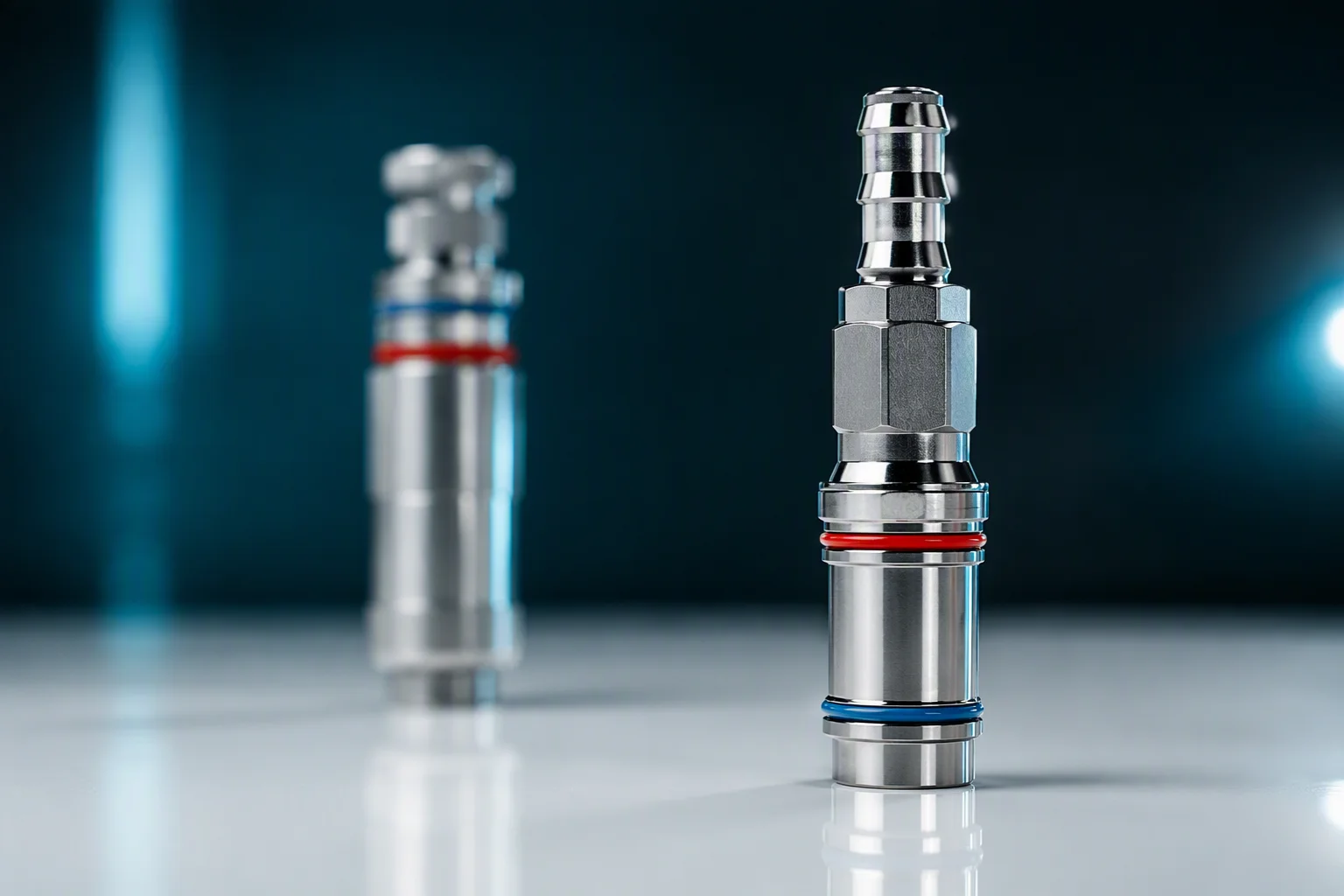
The hand-push dash-04 tier is the workhorse at the cold plate: a nominal 1/4" interface with a 7.14 mm minimum flow bore, sized to fit a 1U envelope on the 44.45 mm EIA pitch. One hand connects it, the red and blue color code keeps hot supply away from cool return, and the 1.7 GPM flow class covers a typical single-server branch with headroom to spare. When the loop runs to a lab rig or a flexible hose assembly, this is the pair that gets specified.
- Cv ≥ 0.80 · 1.7 GPM — OCP dash-04 flow floors
- 44.45 mm pitch — 1U height envelope, rack-density safe
- 0.025 ml — spillage ceiling per disconnect at 0 psi
The dash-04 tier, both ways.
Same OCP tier, two mechanical answers. Where a row shows a floor and a class value, the floor is the OCP requirement and the class value is what published blind-mate and hand-push parts typically deliver.
| Parameter | UQ04 · hand-push | UQDB04 · blind-mate |
|---|---|---|
| The name describes | size class: dash-04 (1/4") OCP tier | interface form: blind-mate, latch-free |
| Mating actuation | single-hand push on a flex line | straight push onto a fixed plane |
| Alignment | technician lines it up | self-aligning, 0.8–1.3 mm class compensation |
| OCP flow class | 1.7 GPM | 1.7 GPM (same tier) |
| Minimum Cv | 0.80 (OCP floor) | 0.80 floor · 1.22 class |
| Flow bore | ØN 7.14 mm (OCP) | 5.7 mm class flow diameter |
| Spillage per disconnect | ≤ 0.025 ml @0 psi | ≤ 0.025 ml @0 psi |
| Working pressure | 100 psi floor · 20 bar class builds | 100 psi floor · 16 bar class (UQDB04) |
| Burst pressure | 300 psi floor · 80 bar class builds | 300 psi floor · 48 bar class (UQDB04) |
| Mate force | light single-hand force | 62 N class at dash-04 |
| Mate cycles | 5000 (OCP floor) | 5000 (OCP floor) |
| Typical seat | cold plates, server service loops, lab rigs | manifold faces, tray headers, rack planes |
Floors per OCP UQD Rev 1.0 (September 2020); class values from published UQDB fact sheets. Order-specific certified drawings govern.
Choose in three questions.
1. Where does the coupling mate?
Fixed plane, hidden behind a tray, aligned by structure? Blind-mate UQDB — the compensation range exists precisely for bolted tolerances. Flexible hose or a visible service line a human connects? Hand-push UQ04, where the alignment system is a thumb and the color code. If a location answers "both", the fixed plane wins: hidden connections are the ones nobody wants to re-aim.
2. What does the branch flow?
Size follows flow, not preference. A single-server branch moves roughly 12 L/min (about 3.2 GPM) at the 1.2 L/min/kW planning baseline — which is already past the dash-06 class rating of 3.0 GPM and comfortably inside dash-08 at 4.7 GPM. The dash-04 tier at 1.7 GPM belongs on cold-plate and sub-branch service, not on a full server feed. Pick the size from the flow table, then pick the form from question one.
3. Who services it, and how often?
Every disconnect is a maintenance event bought back from downtime — and downtime is priced around $9,000 per minute at the average facility. High-frequency trays argue for blind-mate at the manifold so a swap is one push; technician-facing rigs and cold plates argue for hand-push so the connection is visible and tactile. Either way, both valves seal on separation: no drain cart, no drip tray, no towel.
The three questions that follow this brief.
Can a UQDB plug mate with a hand-push UQD socket?
Can I use UQDB and UQ04 in the same loop?
Which seal compound should I pair with either form?
Still deciding? Send both drawings.
We quote UQDB and UQ04 side by side — 48-hour turnaround, MOQ from 50 pieces, standard sets in 15 days, leak and cycle reports in the carton.