OCP UQD versus proprietary ODM couplings.
Both are flat-face dry-break couplings and both will pass a leak test on the bench. The difference is who owns the mating drawing, and that single fact decides second sourcing, spares strategy and whether a 20-year loop can still be repaired in year twelve. This brief compares the open OCP interface with a proprietary ODM design on interchangeability, ratings, locking features and risk.
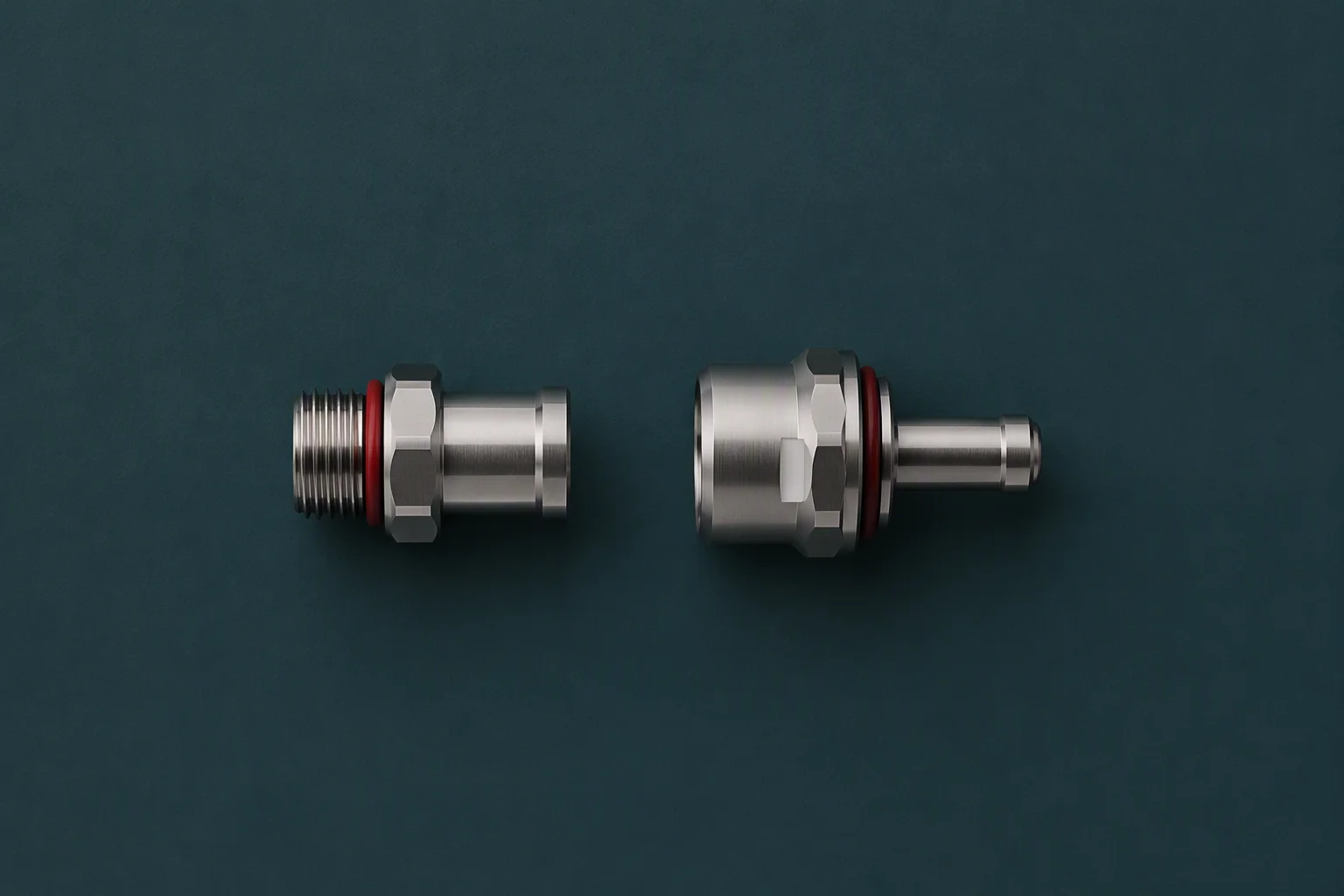
DL-010 · Published 2026-09-06 · 9 min read
Start with what each name describes. OCP UQD is a published hardware envelope: Rev 1.0, issued through the Open Compute Project in September 2020, with contributions from coupling makers, a national laboratory and a server OEM. It fixes interface dimensions, performance floors and coding conventions for four sizes — and deliberately leaves the internals to whoever machines them. A proprietary ODM coupling is the vendor's own design: its own shell, its own latch, its own seal arrangement and its own end connections, sold as a system in which both halves come from one source.
Neither choice is automatically better engineering. A proprietary coupling can be optimised end to end because both halves are designed together; an open interface trades some of that freedom for the ability to buy the same part from someone else in a decade. The decision is a procurement decision, and it should be made on those terms.
What an open interface actually buys.
Precisely one thing, and it is worth being precise about it: any compliant plug mates any compliant socket within the same form family — blind-mate with blind-mate, hand-push with hand-push.
| Property | OCP UQD / UQDB | Proprietary ODM coupling |
|---|---|---|
| Who controls the mating geometry | an open published envelope | the vendor's own drawing |
| Second source | a gauging exercise against published dimensions | a new design and a new qualification |
| Mating across brands | supported within the same form family | only within the vendor's own product line |
| Cross-form mating | not possible — UQDB does not mate hand-push UQD | not applicable — one geometry per vendor |
| Performance consistency | floors are common; measured Cv, spillage and lead time are not | single-vendor consistency, single-vendor exposure |
| Envelope constraint | 1U height on the 44.45 mm EIA pitch, red-hot and blue-cool coding | vendor-defined |
| Spares in year twelve | buy from any compliant supplier | buy from whoever still makes it |
Read the fifth row carefully, because it is where mixed fleets go wrong. Interchangeability is a fit property, not a performance guarantee. Two compliant dash-04 parts both clear the Cv 0.80 floor, and one may deliver a 1.22 class figure while another sits just above the minimum. Both will mate. Only one of them will give you the branch pressure drop you calculated. An Intel-led consortium standardizes cross-brand mating durability on top of the envelope, which helps with fit and cycling — it does not make two vendors' hydraulics equal.
Floors versus claims.
The open standard publishes minimums. A proprietary design publishes whatever it can validate. Both numbers are real; they simply answer different questions.
| Rating | OCP requirement | Published class builds |
|---|---|---|
| Minimum Cv by size | 0.25 / 0.80 / 1.60 / 2.50 | above the floor, e.g. 1.22 at the dash-04 tier |
| Rated flow by size | 0.55 / 1.7 / 3.0 / 4.7 GPM | class figures track the tiers |
| Working pressure | 100 psi maximum, every size | up to 20 bar (290 psi) in the small sizes; 16 bar (about 232 psi) at dash-04 |
| Burst pressure | 300 psi minimum, every size | up to 60 bar (870 psi) in the small sizes; 48 bar (about 696 psi) at dash-04 |
| Mate cycles | 5000 minimum | validated on batch samples |
| Spillage per disconnect | 0.020 / 0.025 / 0.035 / 0.070 ml at 0 psi | measured against the cap for the size |
| Temperature window | 17 to +65 °C coolant; −40 to +75 °C transport and storage | seal-compound dependent within that envelope |
OCP figures are floors from Rev 1.0; class values are typical published figures, and order-specific certified drawings govern production.
A proprietary coupling often wins the headline pressure comparison, and there is nothing dishonest about that: an ODM can thicken a wall, change a thread and qualify the pair as a system, without fitting inside a shared envelope. The question is what the higher number costs. If the claim is 16 bar at the dash-04 tier, ask whether it applies to the mated pair, to the body alone, or to the body at a temperature where the seal compound is still inside its window. A pressure rating is a statement about the weakest element in the boundary, and in a dry-break coupling that element is often the elastomer, not the metal.
Latch and lockout features.
This is the one category where a proprietary design can offer something the open interface deliberately does not — and where the trade-off is genuinely arguable.
The OCP approach: no latch at all
Hand-push UQD mates with a single push and holds on the valve and seal geometry; UQDB is latch-free by design so a tray can be pushed straight onto a manifold face. Retention is the rack's job — rails, stops and tray fixings — not the coupling's. Supply and return ports share the same geometry, so the red-hot and blue-cool coding is the cross-connection control.
The proprietary approach: positive retention
ODM couplings commonly add a thumb latch, a threaded collar or a secondary lock. That buys two things the open interface cannot: a visible confirmation that the joint is fully seated, and resistance to vibration or an accidental pull on a hose. It costs a second hand at the rack, an extra mechanism that can wear or be left unlatched, and a service procedure that has to be followed correctly under time pressure.
The state both designs must eliminate
In either architecture the dangerous condition is the same: a joint that looks closed but has not travelled far enough for both valves to seat. With a latch, the risk is a technician who believes the coupling is locked when only the latch has engaged. Without a latch, the risk is a tray that stops short and looks flush from the aisle. Ask every supplier — open or proprietary — three questions: what is the retention force, does the design permit a partial mate, and how is a fully seated joint confirmed at the rack. If a latch is offered, ask what happens when a tray is pulled with the latch still engaged, because the answer determines whether the failure lands on the coupling or on the tray rail.
Where each path carries procurement risk.
The comparison is not "open good, proprietary bad". It is two different distributions of the same risk.
| Risk | Open OCP interface | Proprietary ODM coupling |
|---|---|---|
| Single-source exposure | low — several compliant suppliers | total — one geometry, one owner |
| Requalification cost | envelope gauging plus a performance check | a new design, new tooling, new validation |
| Performance variance | real — floors are common, Cv and spillage are not | low across a single vendor's line |
| Obsolescence over a 20-year service life class | answered by switching supplier | unanswerable if the line is discontinued |
| Tooling and NRE ownership | not required to buy a standard part | often amortised into your programme |
| Drawing control | you hold the envelope revision | the vendor holds it; you hold a specification |
| Lead time reality | MOQ from 50 pieces, standard sets in 15 days | programme-dependent; custom builds typically 30–45 days |
| Cross-connection protection | coding convention on identical geometry | mechanical keying is possible if the vendor builds it |
Two rows deserve emphasis. The obsolescence row is the one that gets decided today and paid for in year twelve: a loop with a 20-year service life class will outlive several product generations, and the only cheap answer to a discontinued coupling is a published envelope that another supplier can machine against. The performance-variance row is the counterweight: an open interface makes it easy to mix suppliers, and easy to mix performance, so a multi-vendor rack needs a per-vendor record of Cv at design flow and spillage per disconnect rather than a fit check alone.
The commercial mechanics also differ in a way that matters to a purchasing team. With a common interface, three quotations compare like with like — same dash size, same Cv floor, same spillage cap — and the comparison reduces to machining quality, test evidence and lead time. With a proprietary interface, the first comparison is not price at all; it is whether leaving that vendor later is possible, and what the exit would cost.
A decision rule you can defend.
Five lines that hold up in a design review, a sourcing review and a post-incident review alike.
- Default to the open interface — where the loop will be serviced for 15 to 20 years, second sourcing is the cheapest insurance available and the envelope costs nothing to adopt.
- Go proprietary only for a problem the envelope cannot solve — a pressure class well above the 100 psi OCP floor and outside the published class builds, a specialist medium, an integrated sensing function, or an end connection the annex does not cover.
- If you adopt proprietary, contract for the exit — drawings or a source-code equivalent, spares for the whole service life bought up front, and a second source qualified before you need one rather than after.
- Verify the same three things either way — envelope gauging on the batch, measured Cv at your design flow, and spillage per disconnect measured against the cap for the size.
- Keep the interface and the vendor decision separate — an OCP coupling can feed a custom manifold, and a proprietary coupling can sit on an OCP-ported bank. Decide each on its own merits instead of letting one lock the other.
Three questions this brief answers most.
Can an OCP UQD coupling be replaced by a proprietary ODM coupling?
Do proprietary couplings flow more than OCP UQD parts?
Which interface carries more procurement risk?
Compare like with like. Send the dash size and the flow.
DryLink UQD and UQDB sets are gauged against the Rev 1.0 envelope, quoted with the Cv, spillage and leak figures in writing — 48-hour turnaround, MOQ from 50 pieces, standard sets in 15 days.